
Training max and 1RM in plain terms
Your 1RM is the most you can lift once. Your training max (TM) is a lower, working number that you use to calculate the weights for your training sets. Programs built on a training max, such as Jim Wendler’s 5/3/1, set it below your 1RM so that every prescribed set stays manageable. Think of the training max as the number your plan is built on, and the 1RM as the number your plan is measured against.
The Fitness Wiki’s 5/3/1 primer says most variants set the training max at either 85% or 90% of 1RM. The training max also drives progression, because you add weight to it after each cycle.
Why use a number below your max
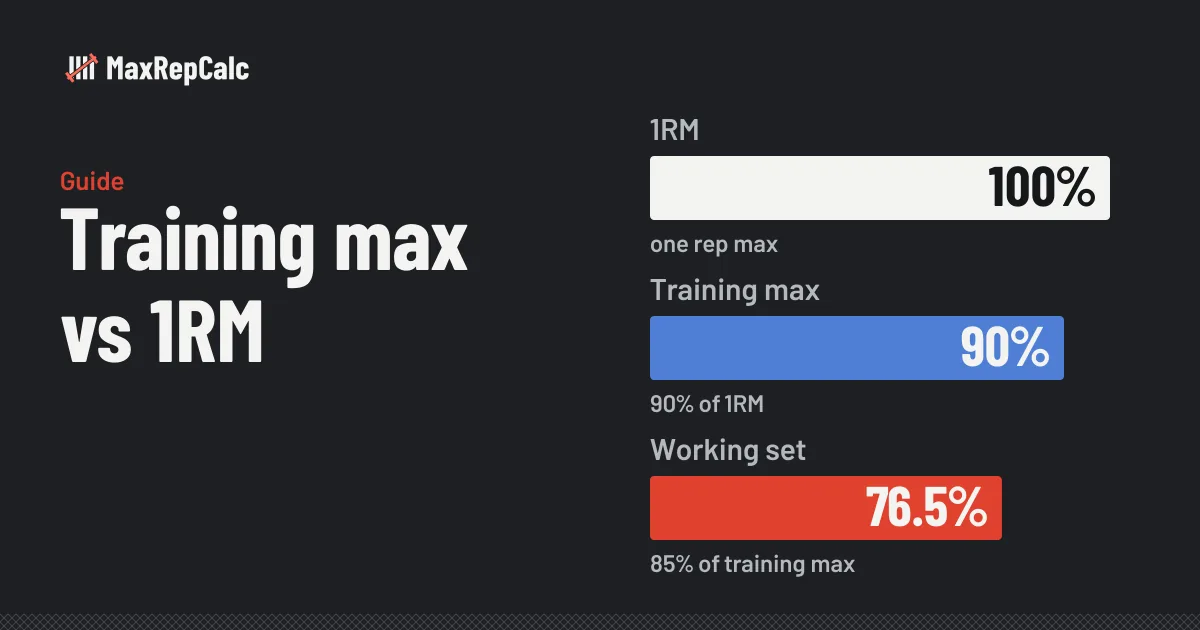
A percentage of a lower number gives lighter sets. If a program calls for 85% of your training max, and your training max is 90% of your 1RM, you are working at 76.5% of your true max (0.85 × 0.90). The result is sets you can repeat week after week without grinding.
Here is a lifter with a 1RM of 150 kg and a 90% training max of 135 kg.
| Program calls for | Weight | Share of true 1RM |
|---|---|---|
| 65% of training max | 87.75 kg | 58.5% |
| 75% of training max | 101.25 kg | 67.5% |
| 85% of training max | 114.75 kg | 76.5% |
Weights are shown before rounding to loadable plates. The same sets built on the true 1RM would feel much heavier and leave less room to recover.
How to set your training max
- Find your 1RM. You do not need to test it. The Fitness Wiki notes that 1RM calculators work fairly reliably for sets of 8 reps or fewer.
- Multiply the 1RM by 0.90, or by 0.85 if you want a more cautious start.
- Round down to a weight you can load.
With a 1RM of 120 kg, a 90% training max is 108 kg and an 85% training max is 102 kg. Use the 1RM calculator to get the 1RM from a hard set.
When to adjust your training max
In 5/3/1 you add weight to the training max after each cycle. The primer also describes a periodic test week to make sure the number is not too high. If a test set gives fewer reps than the program asks for, the training max is too high. Use that set to estimate a new 1RM and reset the training max from it.
Do not read the training max as a score of your strength. The primer for beginners makes the point that it is a working tool, and that submaximal training is an effective way to build strength and muscle.
From a hard set to a training max
A lifter finishes 5 hard reps with 100 kg. The calculator estimates a 1RM of 115.5 kg. A 90% training max is 103.9 kg, and an 85% training max is 98.2 kg. Round either one down to a weight you can load, and use it as the base for every percentage in the program.
Note that the base is lower than the weight the lifter just handled for 5 reps would suggest at a glance. That is the point: the program builds in room, so that early sets feel crisp and the heavy sets in each cycle stay possible.
Common training max mistakes
- Setting it from a set that was not hard. A comfortable set understates your 1RM, and the training max ends up too low to drive progress.
- Raising it too fast. Adding weight every week outruns recovery. Change it at the end of a cycle.
- Comparing it with other lifters. Two people with the same training max can have different true maxes, because the percent they chose differs.
- Forgetting separate numbers per lift. Each lift gets its own training max.
A training max in pounds
The steps are the same in pounds. With a 1RM of 275 lb, a 90% training max is 247.5 lb and an 85% training max is 233.75 lb. Standard plates move the bar in 5 lb steps, so round down to 245 lb or 230 lb. Rounding down keeps the first sets of a cycle comfortable.
Each lift gets its own number
Your bench, squat and deadlift each have a training max, because each lift has its own 1RM. If your bench estimate rises, your squat training max stays where it is until you have a new squat set to estimate from. Keep the numbers in a log with the date and the set they came from.
How hard a training max should feel
A 90% training max sits between the weights you could lift for 3 and 4 reps to failure, since 3 reps is about 91.5% of 1RM and 4 reps is about 88.9%. An 85% training max sits closer to a set of 6. If your program uses RPE as well, the RPE and reps in reserve guide explains how to match effort to those numbers.
The gap between the two bases
Take a lifter with a 1RM of 120 kg and a training max of 108 kg. A program that calls for 80% would ask for 96 kg if it used the 1RM and 86.4 kg if it used the training max. That is a difference of 9.6 kg on one set, and it is why you must know which base your program expects.
Choosing between 85% and 90%
Three questions help you choose:
- How experienced are you? Newer lifters often do better with the lower figure, because their estimates are less settled.
- How well do you recover? Heavy training weeks leave less room for error when sleep and stress are poor.
- How much volume does the program ask for? More sets and reps call for a lower base.
If you are unsure, start at 85%. You can raise it at the end of a cycle, but it is harder to recover from a base that was set too high.
Which number does your program use?
Read the program. Many percent-based plans name the base, either “% of 1RM” or “% of TM.” The NSCA strength, hypertrophy and endurance zones are written as percentages of 1RM, as the HPRC lists them. The 5/3/1 family uses percentages of the training max. Mixing the two bases gives weights that are too heavy or too light.
The gap is large. Using 85% of a 120 kg 1RM gives 102 kg. Using 85% of a 108 kg training max gives 91.8 kg, which is more than 10 kg lighter.
Resetting after a break
Time off, illness or a long deload can lower what you can lift. Do not carry the old training max forward by habit. Do a hard set of 3 to 8 reps, estimate a fresh 1RM from it, and set the training max again. A base that matches your current strength keeps the first week back comfortable.
Training max questions
Is a training max the same as a one rep max?
No. A one rep max is the most you can lift once. A training max is a lower number, usually 85% to 90% of it, used to set working weights. Your true max stays above your training max, and the two answer different questions.
What percent should my training max be?
Most 5/3/1 variants use 85% or 90% of your 1RM, according to the Fitness Wiki primer. Use 90% if you are experienced and recover well. Use 85% if you are new to the program or want sets that feel easier.
Do I need to test my max to set a training max?
No. Take a hard set of 8 reps or fewer, estimate your 1RM with a calculator and multiply by 0.85 or 0.90. The primer notes that calculators are fairly reliable for sets of 8 reps or fewer, so a true max test is not needed.
How do I know my training max is too high?
If you miss the reps a program prescribes, or the sets turn into grinders, the number is too high. Test with a set, estimate a new 1RM from it and reset the training max. Treat the training max as a working tool, not a measure of strength.
Keep reading
- How to test your 1RM safely: when you want a real number behind your training max.
- Rep max chart: weights for every rep count from a known max.
Sources and review
- The Fitness Wiki. 5/3/1 primer (training max). thefitness.wiki.
- The Fitness Wiki. 5/3/1 for beginners. thefitness.wiki.
- Human Performance Resource Center. What is a one-rep max? Published July 5, 2022. hprc-online.org.
These are estimates for training. They are not medical advice. Read the disclaimer.