
What you need before you calculate
You need three things: a weight, a rep count and a set you took close to failure. The best sets run 3 to 8 reps. The NSCA estimation method works from sets of 10 reps or fewer, so stay under that. Write down the weight and the reps as soon as the set ends.
If you stopped with reps left, add them to your count. A set of 5 with 2 reps in reserve counts as 7. Keep the weight in one unit from start to finish.
Step by step with the Epley formula
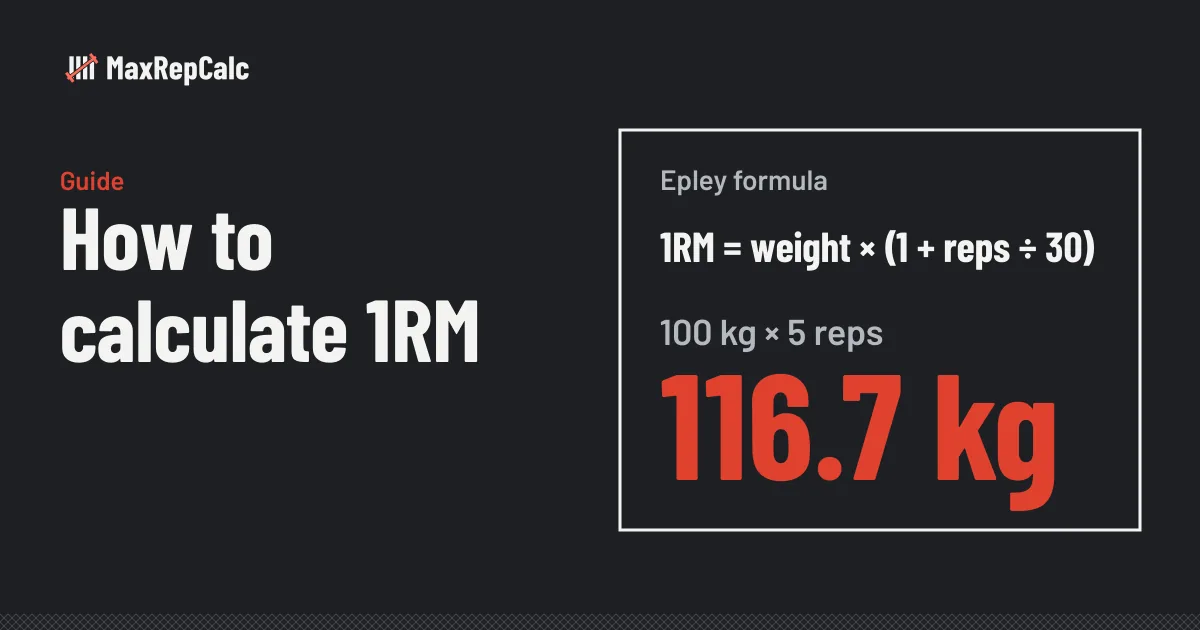
Epley’s formula is 1RM = weight × (1 + reps ÷ 30). Work through it in three steps with 100 kg for 5 reps.
- Divide the reps by 30: 5 ÷ 30 = 0.1667.
- Add 1: 1 + 0.1667 = 1.1667.
- Multiply by the weight: 100 × 1.1667 = 116.7 kg.
The Epley estimate is 116.7 kg. Round to the nearest loadable weight when you plan a lift.
Step by step with the Brzycki formula
Brzycki’s formula is 1RM = weight × 36 ÷ (37 − reps). For the same set:
- Subtract the reps from 37: 37 − 5 = 32.
- Divide 36 by that number: 36 ÷ 32 = 1.125.
- Multiply by the weight: 100 × 1.125 = 112.5 kg.
Brzycki’s 1993 article writes the same formula with decimals, as weight ÷ (1.0278 − 0.0278 × reps). Multiplying through gives the whole number form used above.
The two answers differ by about 4.2 kg. That gap is normal. Averaging several formulas smooths it out, which is what the calculator does: the mean for this set is 115.5 kg. The Epley vs Brzycki guide explains why the two split.
The percentage method
You can skip the formulas and use a chart. The NSCA training load chart, as the HPRC explains it, treats a 5 rep max as about 87% of your 1RM. Divide the weight by the percent written as a decimal: 100 ÷ 0.87 = 114.9 kg.
The mean of the seven formulas gives 115.5 kg for the same set, so the two methods agree to within 1 kg. The rep max chart lists the percent for every rep count from 1 to 12.
Spreadsheet formulas you can copy
Put the weight in cell A2 and the reps in cell B2. Then paste one formula per column, starting in column C. The mean sits in column J.
| Formula | Paste into the cell |
|---|---|
| Epley | =A2*(1+B2/30) |
| Brzycki | =A2*36/(37-B2) |
| Lander | =100*A2/(101.3-2.67123*B2) |
| Lombardi | =A2*B2^0.1 |
| Mayhew | =100*A2/(52.2+41.9*EXP(-0.055*B2)) |
| O’Conner | =A2*(1+0.025*B2) |
| Wathan | =100*A2/(48.8+53.8*EXP(-0.075*B2)) |
| Mean of the seven | =AVERAGE(C2:I2) |
These formulas assume 2 or more reps. At 1 rep your 1RM is the weight itself, so wrap each formula in IF(B2=1,A2,...) if you log single reps. Brzycki has no answer at 37 reps, which is far beyond a useful set anyway.
Work backward: the weight for a target rep count
Sometimes you know your 1RM and want a weight for a set. Multiply the 1RM by the percent for that rep count. With a 1RM of 115.5 kg, a set of 8 uses 80.2%, which is 92.6 kg. A set of 3 uses 91.5%, which is 105.7 kg. The rep max chart lists the percent for every rep count.
Which set to use when you did several
Use the heaviest set that you took close to failure. Do not average sets from different rep ranges, and do not use a warm-up set. If you did 3 sets of 5 at the same weight, use the last one, since fatigue makes it the closest to your limit and the least likely to overstate your strength.
Estimates for common sets
Here are five sets you might do, run through all seven formulas. The percent gap between sets is the same in any unit, so you can scale the numbers to your own weights.
| Set | Mean estimate | Range of the seven formulas |
|---|---|---|
| 60 kg × 10 | 78.6 kg | 75.0 to 80.8 kg |
| 100 kg × 8 | 124.7 kg | 120.0 to 127.7 kg |
| 100 kg × 5 | 115.5 kg | 112.5 to 119.0 kg |
| 100 kg × 3 | 109.3 kg | 105.9 to 114.0 kg |
| 140 kg × 3 | 153.0 kg | 148.2 to 159.6 kg |
Notice how the range between the lowest and highest formula grows for the longer sets. That is the signal to treat an estimate from a set of 8 or 10 as looser than one from a set of 3.
Working in pounds
The sums do not change in pounds. Take 225 lb for 5 reps. Epley gives 262.5 lb, Brzycki gives 253.1 lb, and the mean of all seven formulas is 259.9 lb. Round down to the nearest 5 lb when you plan the lift, because the smallest plate pair on a standard bar adds 5 lb.
Sanity checks before you trust the number
- Compare it with your last estimate. A jump of more than a few percent deserves a second look at the rep standard.
- Check the range. A wide range means the set was long or the formulas disagree about your rep count.
- Use the rep table. The weight for 5 reps should feel like a hard 5, not an easy one.
- Check the unit. Entering pounds as kilograms is the most common slip.
A full example, from set to plan
Here is the whole process for one lifter. She benches 90 kg for 6 hard reps and wants working weights for the next block.
- Epley gives 108.0 kg and Brzycki gives 104.5 kg.
- The mean of all seven formulas is 106.7 kg, with a range of 103.5 to 109.3 kg.
- She plans sets of 5 reps, which sit near 86.6% of 1RM. That works out to about 92.4 kg.
- She loads the nearest weight she can build, and notes the date, the weight and the reps in her log.
If the lower end of the range feels safer, she can start there and move up as the weights feel easy. The point is that the number is a starting place, and the bar tells her the rest.
When a formula gives a strange answer
Formulas are built for sets of about 2 to 10 reps. Outside that range they can give odd results. Brzycki has no answer at 37 reps and climbs steeply before that. At 1 rep the Epley formula returns more than the weight you lifted. If a result looks wrong, check the rep count first, and then shorten the set.
Common mistakes when you calculate by hand
- Using long sets. A set of 15 or 20 reps pushes every formula past the range it was built for.
- Mixing units. Keep kilograms or pounds throughout. To convert, multiply pounds by 0.4536 to get kilograms.
- Rounding early. Keep the decimals until the last step, then round the answer.
- Ignoring reps in reserve. A set that stopped short of failure understates your max unless you add the reps you had left.
Check your answer
Run the same set through the 1RM calculator to check your arithmetic. It returns the mean, the range and the result of each formula, so you can compare every step with your own working.
Calculating a 1RM: questions
What is the easiest way to find a 1RM?
Use a calculator. Enter the weight and reps from a hard set of 3 to 8 reps, and it returns an estimate. If you prefer paper, use Epley’s formula: multiply the weight by 1 plus the reps divided by 30. A spreadsheet makes repeat checks quick.
Which formula should I use by hand?
Pick Epley if you want the simpler sum. Pick Brzycki if you want a second opinion to compare. Neither is the clear winner in studies, so averaging both is a fair compromise. Whichever you choose, use it every time so your numbers stay comparable.
Does the formula change for pounds?
No. The formulas work in any unit as long as you use the same unit throughout. A set of 225 lb for 5 reps gives 262.5 lb with Epley. Convert to kilograms afterward, if you need to, by multiplying pounds by 0.4536.
Can I calculate a 1RM from a single rep?
A single rep needs no formula, because the weight is your 1RM if the rep was a true max effort. If it felt easy, your real max is higher. In that case, take a heavier single or use a set of 3 to 5 reps near failure to estimate it.
Keep reading
- How to test your 1RM safely: what to do when you want a real number.
- Training max guide: how to turn your result into working weights.
Sources and review
- Epley B. Boyd Epley Workout. 1985.
- Brzycki M. Strength testing: predicting a one-rep max from reps-to-fatigue. Journal of Physical Education, Recreation & Dance. 1993;64(1):88-90. doi:10.1080/07303084.1993.10606684
- Human Performance Resource Center. What is a one-rep max? Published July 5, 2022. hprc-online.org.
- National Strength and Conditioning Association. Training load chart. nsca.com (PDF).
- LeSuer DA, McCormick JH, Mayhew JL, Wasserstein RL, Arnold MD. The accuracy of prediction equations for estimating 1-RM performance in the bench press, squat, and deadlift. Journal of Strength and Conditioning Research. 1997;11(4):211-213. Abstract
These are estimates for training. They are not medical advice. Read the disclaimer.