
Should you test a true 1RM at all?
Most lifters do not need to. A true test is a maximal effort, and the American Council on Exercise says it is not appropriate for beginners. The NSCA protocol adds that when a test is not warranted for your experience or safety, you should estimate from a multiple-rep set instead.
Test when you compete, when a program needs a real number, or when you have the experience and the setup to do it safely. Otherwise, estimate it with the 1RM calculator and save the heavy attempts for the platform.
What you need before you start
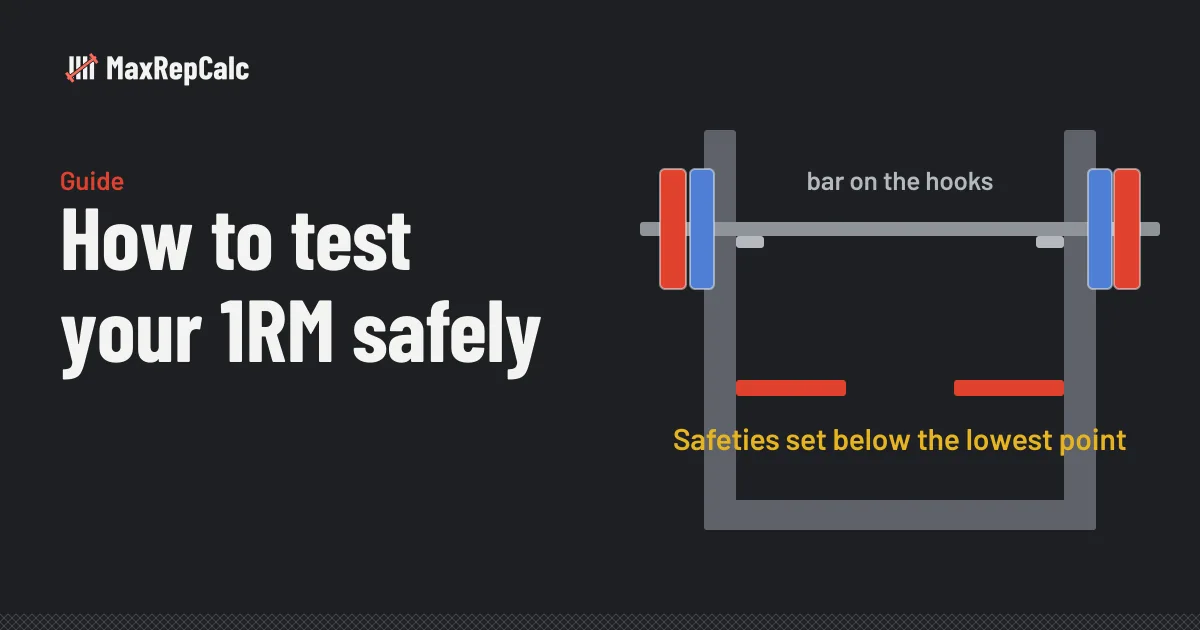
- A rack with safety bars or pins set below the lowest point of the lift, for the squat and the bench press.
- An experienced spotter for the bench press and the squat, with the signals agreed before the set.
- Collars or clips on the bar, and the load balanced evenly on both sides.
- A clear floor around the bar, and shoes and clothing that let you move well.
- A rested body. Skip the test after a hard session or a poor night of sleep.
The NSCA protocol, step by step
The National Strength and Conditioning Association recommends this sequence, as the Human Performance Resource Center summarizes it. Upper body and lower body lifts use different jumps in weight. Each jump is added to the weight of the previous set.
| Set | Reps | Rest after | Upper body: add | Lower body: add |
|---|---|---|---|---|
| 1. Warm-up | 5 to 10, easy | 1 minute | Start light | Start light |
| 2. Build | 3 to 5 | 2 minutes | 10 to 20 lb (4 to 9 kg) or 5 to 10% | 30 to 40 lb (14 to 18 kg) or 10 to 20% |
| 3. Near max | 2 to 3 | 2 to 4 minutes | 10 to 20 lb (4 to 9 kg) or 5 to 10% | 30 to 40 lb (14 to 18 kg) or 10 to 20% |
| 4. First attempt | 1 | 2 to 4 minutes | 10 to 20 lb (4 to 9 kg) or 5 to 10% | 30 to 40 lb (14 to 18 kg) or 10 to 20% |
| After a made attempt | 1 | 2 to 4 minutes | Add the same jump again | Add the same jump again |
| After a miss | 1 | 2 to 4 minutes | Remove 5 to 10 lb (2 to 4 kg) or 2.5 to 5% | Remove 15 to 20 lb (7 to 9 kg) or 5 to 10% |
Keep going until you complete one rep with proper technique. The NSCA excerpt says this should ideally happen within three to five testing attempts. Kilogram values for the lower body are rounded conversions from the pound figures.
How to choose the first attempt
The protocol builds up from a light first set, so how heavy to make each set is your call. A practical approach is to estimate your max from a recent hard set, then plan the ramp so that the near-maximal set of 2 to 3 reps sits a little under that estimate and the first 1RM attempt lands near it. Many coaches add an extra ramp set or two when the gap between an easy first set and the estimate is large.
This is a coaching habit, not part of the NSCA text. Whatever ramp you choose, keep the rests in the table, because fatigue is what turns a good max attempt into a miss.
Checks for each lift
- Bench press: keep five points of contact (head, upper back and hips on the bench, both feet on the floor), grip the bar with your thumbs around it and never use a false grip. See the bench press 1RM calculator for rep standards.
- Squat: set the safety bars just below your lowest position, or use a spotter at each end of the bar. Multiple-rep squat tests lose reliability above 5 reps. See the squat 1RM calculator.
- Deadlift: a spotter cannot help, so clear the floor, brace before each pull and stop when your form changes. See the deadlift 1RM calculator.
A sample test day timeline
The rests in the NSCA protocol add up. Here is what a test with the three build sets and three attempts looks like, using the rests from the table above.
- Finish your general warm-up, then do the light first set of 5 to 10 reps. Rest 1 minute.
- Do the set of 3 to 5 reps. Rest 2 minutes.
- Do the set of 2 to 3 reps. Rest 2 to 4 minutes.
- Make the first attempt. Rest 2 to 4 minutes.
- Make the second attempt, and a third if needed, with the same rest between them.
That is roughly 9 to 15 minutes of rest plus the time under the bar, so plan on about 15 to 25 minutes after your general warm-up. Do not rush the rests to save time.
Talking with your spotter
The NSCA excerpt asks for an experienced spotter and clear communication. Agree the plan before the first attempt:
- Who helps with the lift-off, and on what signal.
- When the spotter should step in, and what you will say or do to ask for help.
- Who counts, and whether the spotter should touch the bar only after you stop moving it.
- For the squat, what happens if you miss: lower to the safeties or bail out of the lift.
Common mistakes on test day
- Skipping the warm-up. A cold start makes the first attempts feel heavier and raises the risk.
- Jumping too far between attempts. Big jumps leave you tired and without a good attempt left.
- Testing several lifts in one session. Fatigue from the first lift will lower the second.
- Changing technique to grind out a rep. If the standard changes, the number no longer matches your earlier ones.
- Ignoring how you feel. Poor sleep or pain is a good reason to postpone.
When to stop
- Stop when your technique changes, even if the bar is still moving.
- Stop when you do not feel mentally ready for the next attempt. The NSCA excerpt lists readiness as part of the setup.
- Stop when your spotter tells you to.
- Aim to finish within three to five attempts. Fatigue builds with each lift, so long ladders get harder to do well.
If you cannot test: multiple-rep tests
The HPRC lists a multiple-rep test as a good option when you lift alone and have no spotter. For a 10 rep max, find the most weight you can lift 10 times but not 11. It suits big lifts such as the bench press and the deadlift. For the back squat, the HPRC says form breaks down quickly, so keep the test to 5 reps or fewer.
Then convert the result. The NSCA chart puts a 5 rep max at about 87% of 1RM, so 100 kg for 5 hard reps points to a 1RM near 115 kg. The calculator does this for any set and shows the range.
If you rarely max a lift
Be more careful with a lift you have never taken close to a max. Choose smaller jumps between attempts, stay inside the NSCA ranges, and keep your spotter or safeties in place for every attempt. A conservative first attempt costs you little. A missed one that you were not prepared for can cost a lot.
After the test
Write down the weight, the date, the equipment and the rep standard, such as the depth or the pause. Re-check at the end of your next training block, not next week. Then use the result to set working weights. The training max guide shows how.
1RM testing questions
How many attempts does a max test take?
The NSCA excerpt says a 1RM should ideally be reached within three to five testing attempts after the warm-up sets. More attempts mean more fatigue, which makes each later lift harder. If you have not found your max by attempt five, stop and retest on another day.
How long should I rest between attempts?
Rest 1 minute after the first warm-up set and 2 minutes after the next. Then rest 2 to 4 minutes before and between 1RM attempts, as the NSCA protocol advises. Use a clock instead of guessing, because a long wait feels shorter than it is.
Can I test my max alone?
It is much riskier. Use a rack with safety bars set for the lift, or choose a multiple-rep test instead. The HPRC lists a multiple-rep test as a good option when you lift alone. For the deadlift a spotter cannot help anyway, so preparation matters most.
Should I test every lift on the same day?
Most lifters test one lift per session. Fatigue from the first max lowers the second, so the later numbers would not match your earlier ones. If you must test more than one lift, start with the one that matters most and rest fully between them.
Is a max test safe for beginners?
The American Council on Exercise advises against true 1RM tests for beginners, because technique is still forming. A predicted 1RM from a lighter set gives a useful number with far less risk. Test a true max only after your technique is solid.
Keep reading
- How to calculate 1RM guide: estimate your max without a test.
- What is a one rep max: the meaning behind the number.
Sources and review
- Human Performance Resource Center. What is a one-rep max? Published July 5, 2022. hprc-online.org.
- National Strength and Conditioning Association. 1RM or estimated 1RM bench press (testing protocol). In: Strength Training for Baseball. Human Kinetics. Excerpt.
- American Council on Exercise. Understanding 1-RM and predicted 1-RM assessments. acefitness.org.
- Haff GG, Triplett NT, Sheppard JM. Program design for resistance training. In: Haff GG, Triplett NT, eds. Essentials of Strength Training and Conditioning. 4th ed. Human Kinetics; 2016:444-458.
These are estimates for training. They are not medical advice. Read the disclaimer.