
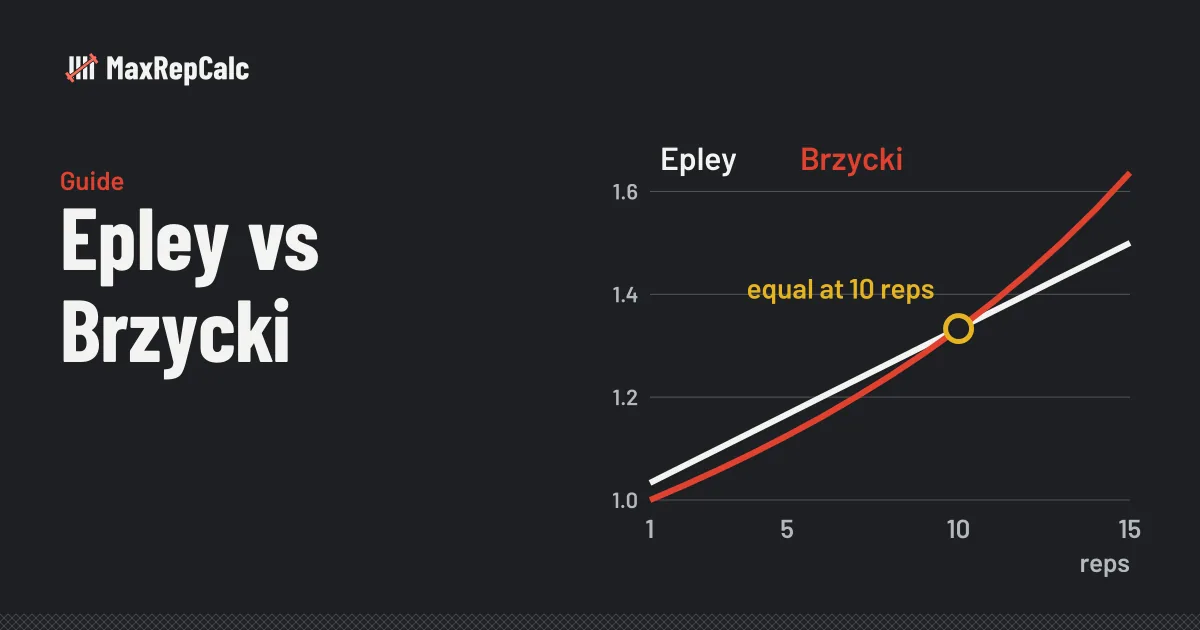
The two formulas side by side
Boyd Epley published his formula in 1985. Matt Brzycki published his in 1993, in an article titled “Strength Testing: Predicting a One-Rep Max from Reps-to-Fatigue.” Both multiply the weight by a factor that grows with the rep count.
- Epley: 1RM = weight × (1 + reps ÷ 30)
- Brzycki: 1RM = weight × 36 ÷ (37 − reps)
Brzycki’s article writes his formula as weight ÷ (1.0278 − 0.0278 × reps), which is the same sum with decimals. He also wrote that it is only valid for fewer than 10 reps to fatigue, and less accurate beyond about 10.
Epley’s factor grows by the same step for every rep: one thirtieth, or 3.3% of the weight. Brzycki’s factor grows faster as reps climb, because the number you divide by keeps shrinking.
How the two factors compare
Multiply your weight by the factor to get a 1RM. Here is each formula’s factor at common rep counts.
| Reps | Epley multiplier | Brzycki multiplier | Epley vs Brzycki |
|---|---|---|---|
| 1 | 1.033 | 1.000 | +3.3% |
| 2 | 1.067 | 1.029 | +3.7% |
| 3 | 1.100 | 1.059 | +3.9% |
| 4 | 1.133 | 1.091 | +3.9% |
| 5 | 1.167 | 1.125 | +3.7% |
| 6 | 1.200 | 1.161 | +3.3% |
| 8 | 1.267 | 1.241 | +2.0% |
| 10 | 1.333 | 1.333 | 0.0% |
| 12 | 1.400 | 1.440 | −2.8% |
| 15 | 1.500 | 1.636 | −8.3% |
| 20 | 1.667 | 2.118 | −21.3% |
| 30 | 2.000 | 5.143 | −61.1% |
Read the last column as how far Epley sits above or below Brzycki. At 3 reps Epley is 3.9% higher. At 12 reps it is 2.8% lower.
Where the two formulas agree
The formulas give the same factor, 1.333, at exactly 10 reps. A set of 10 with 60 kg returns 80.0 kg from either one. Everywhere else they split. Epley reads higher below 10 reps, and Brzycki reads higher above 10.
What each formula says at one rep
At 1 rep Brzycki returns exactly your weight, because 36 ÷ 36 is 1. Epley returns 1.033 times your weight, so a single at 100 kg becomes 103.3 kg. The calculator on this site treats a single rep as the weight itself for all seven formulas, so this quirk never reaches your result.
Why neither formula works at high reps
Brzycki’s denominator reaches zero at 37 reps, so the formula has no answer there, and it climbs steeply on the way. At 30 reps its factor is 5.14, which would turn a 20 kg set into a 103 kg max. Epley’s factor at 30 reps is 2.00. That is steadier, but a set of 30 still says more about endurance than about strength.
The NSCA’s own estimation table stops at 10 reps, and so does the table in Brzycki’s article. Treat 10 reps as your ceiling, and prefer sets of 3 to 8 reps.
The other five formulas
The calculator also uses Lander, Lombardi, Mayhew, O’Conner and Wathan. Lander uses a ratio like Brzycki’s. Lombardi raises reps to a power. Mayhew and Wathan use exponential curves. O’Conner is linear like Epley, but it adds 2.5% of the weight per rep instead of 3.3%.
Here is a set of 8 reps with 100 kg, run through all seven.
| Formula | Estimated 1RM |
|---|---|
| Epley | 126.7 kg |
| Brzycki | 124.1 kg |
| Lander | 125.1 kg |
| Lombardi | 123.1 kg |
| Mayhew | 126.3 kg |
| O'Conner | 120.0 kg |
| Wathan | 127.7 kg |
| Mean | 124.7 kg |
The seven values run from 120.0 kg to 127.7 kg, a spread of 6.2% of the mean.
How far apart the seven formulas drift
The disagreement grows with the rep count. For a 100 kg set, the seven formulas spread about 7.4% of the mean at 3 reps, 5.6% at 5 reps, 6.2% at 8 reps and 7.4% at 10 reps. A short, heavy set gives a tighter answer than a long, light one, whichever formula you prefer.
That is why the calculator shows the range next to the mean. A narrow range tells you the formulas agree. A wide range tells you the set was long enough that the estimate should be read loosely.
How the estimates change with your rep range
Here is what each formula returns for a 100 kg set at five different rep counts.
| Reps | Epley | Brzycki |
|---|---|---|
| 3 | 110.0 kg | 105.9 kg |
| 5 | 116.7 kg | 112.5 kg |
| 8 | 126.7 kg | 124.1 kg |
| 10 | 133.3 kg | 133.3 kg |
| 12 | 140.0 kg | 144.0 kg |
For sets under 10 reps, treat Brzycki as the cautious figure and Epley as the optimistic one. The truth for most lifters sits between them. For sets above 10 reps the roles flip, which is one more reason to avoid long sets when you want an estimate.
How the choice changes your program
The formula you pick changes the weights you load. Take 100 kg for 5 reps. Epley gives 116.7 kg and Brzycki gives 112.5 kg. A program that calls for 85% of your max would then ask for 99.2 kg on one formula and 95.6 kg on the other.
That is a gap of about 3.6 kg on a single set. It is small, but it adds up over a block, and it shows why you should pick a formula and stay with it, or use the mean and read the range.
Why averaging helps
Each formula has its own bias. One runs high at low reps and another runs high at high reps. Averaging seven of them cancels some of those biases, and the spread between them tells you how much to trust the result. It is not magic. Averaging cannot fix a set that had loose reps, but it does stop one formula’s quirks from deciding your number.
Three common rep counts compared
The easiest way to feel the difference is to look at the sets most lifters actually do.
- 3 reps at 100 kg: Epley gives 110.0 kg, Brzycki gives 105.9 kg and the mean is 109.3 kg. Epley sits 3.9% above Brzycki.
- 5 reps at 100 kg: Epley gives 116.7 kg, Brzycki gives 112.5 kg and the mean is 115.5 kg. Epley sits 3.7% above Brzycki.
- 10 reps at 100 kg: both formulas give 133.3 kg, and the mean of all seven is 131.0 kg.
The two formulas are closest in the middle of the range and farthest apart at the extremes. Because both are linear in weight, the percent gap is the same whether you lift 20 kg or 200 kg.
A note on rounding
Both formulas return decimals, such as 116.7 kg. A bar cannot be loaded to a tenth of a kilogram, so round to the nearest weight you can build. When two formulas differ by less than one plate step, the difference does not matter in practice.
Which formula should you use?
Studies do not name one winner. LeSuer and colleagues compared seven equations on 67 untrained college students and found every one tracked measured 1RM with a correlation above 0.95. Differences between formulas were small next to the differences between lifts.
In practice your habits matter more than the formula. Use sets of 3 to 8 reps, take them near failure and keep your technique steady. If you want one formula, choose either and stay with it, so your numbers stay comparable over time. If you want the cautious option, use the mean of several and read the range, as the 1RM calculator does.
The quick rules
- Sets of 3 to 5 reps: expect Epley to read higher, and treat Brzycki as the cautious figure.
- Sets of about 10 reps: the two formulas agree, so either one will do.
- Sets of 12 reps or more: avoid them for estimating, or use the mean and read the range.
Epley and Brzycki: questions
Is Epley or Brzycki more accurate?
Neither is consistently more accurate. LeSuer and colleagues found strong correlations for all seven equations they tested. Epley reads higher below 10 reps and Brzycki reads higher above it, so the better choice depends on your rep range. Averaging the two covers both.
Why do Epley and Brzycki give different answers?
They use different curves. Epley adds a fixed amount of weight for each rep. Brzycki’s factor grows faster as reps climb. The two meet at 10 reps and drift apart on either side, as the table above shows.
Which formula is best for a set of 5?
At 5 reps Epley gives 116.7 kg for a 100 kg set and Brzycki gives 112.5 kg. Neither is proven closer to the truth. Treat the pair as a range, or use the calculator to see all seven formulas side by side.
What is the best formula for high reps?
Avoid high reps. Sets above 10 reps push every formula outside the range it was built for, and Brzycki fails completely at 37 reps. Take a heavier set of 3 to 8 reps near failure for a better estimate.
Keep reading
- How to calculate 1RM guide: both formulas worked step by step, with spreadsheet versions.
- Rep max chart: the mean percent and the range for every rep count.
Sources and review
- Epley B. Boyd Epley Workout. 1985.
- Brzycki M. Strength testing: predicting a one-rep max from reps-to-fatigue. Journal of Physical Education, Recreation & Dance. 1993;64(1):88-90. doi:10.1080/07303084.1993.10606684
- LeSuer DA, McCormick JH, Mayhew JL, Wasserstein RL, Arnold MD. The accuracy of prediction equations for estimating 1-RM performance in the bench press, squat, and deadlift. Journal of Strength and Conditioning Research. 1997;11(4):211-213. Abstract
- National Strength and Conditioning Association. 1RM or estimated 1RM bench press (testing protocol). In: Strength Training for Baseball. Human Kinetics. Excerpt.
These are estimates for training. They are not medical advice. Read the disclaimer.