
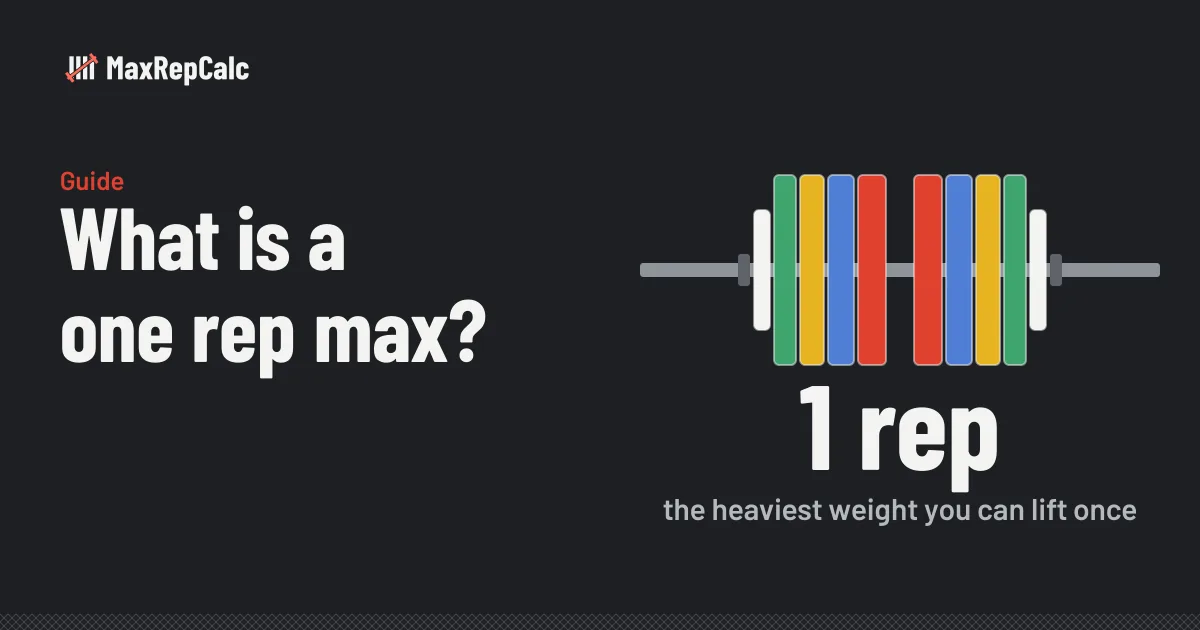
One rep max meaning
A one rep max, written 1RM, is the heaviest weight you can lift for one repetition of an exercise with good technique. The Human Performance Resource Center describes it as the most you can lift once, but not twice. If you can bench press 100 kg one time and fail on the second rep, your bench press 1RM is 100 kg.
Every exercise has its own 1RM. Your squat max says nothing exact about your bench press max, and a front squat max differs from a back squat max. When someone quotes a 1RM, ask which lift they mean and which standard they used for depth, pause and lockout.
The word “max” means the most weight you can lift with proper technique, not the most you can heave. A rep with poor depth or a bounced bar does not count.
True 1RM versus estimated 1RM
There are two ways to find a 1RM. A true 1RM test builds up through heavier and heavier singles until you miss. An estimated 1RM comes from a lighter set taken near failure, which you run through a formula or a chart.
A true test gives the real number, but it asks a lot of your body and carries more risk. The American Council on Exercise says true 1RM testing is not appropriate for beginners. The NSCA protocol says that when a test is not warranted for the lifter’s experience or safety, you should estimate from a multiple-rep set instead.
Estimates work from sets of about 10 reps or fewer. For the back squat, the HPRC says multiple-rep tests are not very reliable above 5 reps because form breaks down. The 1RM calculator on this site does the math and shows a range, so you can see how firm the number is.
Why lifters use a 1RM
A 1RM gives you a reference point. Programs often prescribe weights as a percent of it, and the NSCA recommends different loads for different goals, as the HPRC summarizes:
- Muscular strength: 4 to 6 reps at 85% of 1RM or more.
- Muscular hypertrophy: 6 to 12 reps at 67% to 85% of 1RM.
- Muscular endurance: 12 reps or more at less than 67% of 1RM.
Say your bench press 1RM is 100 kg. A strength set of 5 would use at least 85 kg. A hypertrophy set of 10 would sit between 67 kg and 85 kg.
A 1RM also lets you track progress. If your estimated bench press moves from 100 kg to 105 kg over a training block, you have a number that shows the work paid off.
How reps map to a percent of 1RM
The more reps you can do with a weight, the lower that weight is as a share of your max. The NSCA training load chart, as the HPRC describes it, puts a 5 rep max at about 87% of 1RM. On the mean of the seven formulas used here, 5 reps is 86.6%.
For reference, 3 reps is about 91.5% of your 1RM, 8 reps about 80.2% and 10 reps about 76.3%. The rep max chart lists every rep count from 1 to 12.
Examples of a one rep max
- A tested max: a lifter squats 140 kg once with full depth and misses 142.5 kg. The squat 1RM is 140 kg.
- An estimated max: a lifter who squats 120 kg for 5 reps has an estimated 1RM near 138.6 kg.
- Different lifts, different numbers: the same lifter may bench press 90 kg and deadlift 180 kg. Each is a separate 1RM.
What a 1RM does not tell you
A 1RM measures one rep. It says little about how many reps you can do at lighter weights, how fast you move the bar, or how well you recover between sessions. It can also vary from day to day with sleep, stress and warm-up. Treat it as a useful number, not a full picture of your strength.
A short history of the 1RM
- 1985: Boyd Epley publishes the formula that now carries his name, in the Boyd Epley Workout.
- 1993: Matt Brzycki publishes his formula in the Journal of Physical Education, Recreation & Dance, with a table that runs from 1 to 10 reps.
- 1997: LeSuer and colleagues compare seven equations on 67 untrained college students and find that all of them track measured 1RM closely.
- 2016: Zourdos and colleagues publish the reps in reserve version of the RPE scale, which lets lifters tie effort to a 1RM.
The tools in this site draw on that work. They apply the published formulas, and they show the range so you can see how much the choice of formula matters.
How to keep a 1RM log
A log turns single numbers into a trend. Write down the same few things each time you do a hard set:
| Date | Lift | Weight and reps | Left in reserve | Notes |
|---|---|---|---|---|
| Week 1 | Bench press | 80 kg × 6 | 0 | Paused reps, flat bench |
| Week 5 | Bench press | 82.5 kg × 6 | 0 | Same standard |
Keep the rep standard in the notes, because a change in depth or pause can move your estimate more than a month of training. Compare like with like, and look at the trend over a block, not a single set.
What counts as a good 1RM?
There is no single answer. A good 1RM depends on your body weight, sex, age, training history and the lift. Published strength standards also disagree with one another. We do not publish a standards table, because we have not found a source we can verify. The most reliable comparison is your own past numbers measured the same way.
Who needs a 1RM
You need a 1RM if you follow a percent based program, if you compete, or if you want a simple number to track. You do not need one if you train by effort alone, using reps in reserve or RPE. Even then, an estimate is handy for comparing blocks and for planning a deload or a peak.
Common mistakes with a 1RM
- Mixing lifts. Use a separate number for each exercise and each variation.
- Counting loose reps. Reps with a bounce, a half squat or a spotter’s help inflate the result.
- Testing too often. Maximal attempts are tiring. Re-check at the end of a training block, not every week.
- Comparing different standards. A gym max and a competition max may use different depth, pause and lockout rules.
One rep max questions
Is a one rep max the same as a PR?
Not always. A personal record can be any best result, such as the most reps at 100 kg. A one rep max is the best single. Your 1RM is one kind of PR, and many lifters keep a separate record for each rep range.
Can a beginner find a 1RM?
A beginner can estimate it from a lighter set. The American Council on Exercise advises against true max testing for new lifters, because technique is still forming. Use a set of 3 to 8 reps, enter it into a calculator and re-check after each block of training.
How do I find my one rep max without testing?
Lift a weight for 3 to 8 hard reps, then run the weight and reps through a formula or the calculator. A hand calculation uses Epley’s formula: multiply the weight by 1 plus the reps divided by 30. The how to calculate 1RM guide shows the steps.
What is the difference between a 1RM and a 5RM?
A 5RM is the most you can lift for five reps, and a 1RM is the most you can lift once. A 5RM is lighter, at about 87% of 1RM on the NSCA chart, so it is easier to test and carries less risk. Many lifters use a 5RM to estimate a 1RM.
How often does a 1RM change?
It changes as you train, so many lifters re-check it at the end of a training block. If your estimate moves by more than a few percent between two checks, make sure your technique and rep standard matched before you trust the change.
Keep reading
- How to test your 1RM safely: the NSCA sequence and the safety checks.
- Training max guide: why many programs work from a lower number.
Sources and review
- Human Performance Resource Center. What is a one-rep max? Published July 5, 2022. hprc-online.org.
- National Strength and Conditioning Association. Training load chart. nsca.com (PDF).
- National Strength and Conditioning Association. 1RM or estimated 1RM bench press (testing protocol). In: Strength Training for Baseball. Human Kinetics. Excerpt.
- American Council on Exercise. Understanding 1-RM and predicted 1-RM assessments. acefitness.org.
- Haff GG, Triplett NT, Sheppard JM. Program design for resistance training. In: Haff GG, Triplett NT, eds. Essentials of Strength Training and Conditioning. 4th ed. Human Kinetics; 2016:444-458.
These are estimates for training. They are not medical advice. Read the disclaimer.