
RPE and reps in reserve in plain terms
RPE stands for rating of perceived exertion. It is a 1 to 10 score for how hard a set felt. Reps in reserve, or RIR, counts how many more reps you could have done with good technique when you stopped. The two ideas are linked, and lifters often use them together.
Zourdos and colleagues published the reps in reserve version of the RPE scale in 2016, in the Journal of Strength and Conditioning Research. They describe it as a practical way to regulate training load from day to day and to give feedback during a 1RM test. It is popular because it needs no equipment. You only need to be honest about how many reps you had left.
That matters for estimating a max. A set stopped well short of failure understates your strength, and the reserve box in the 1RM calculator corrects for that by adding the reps you had left.
The scale: RPE and reps left
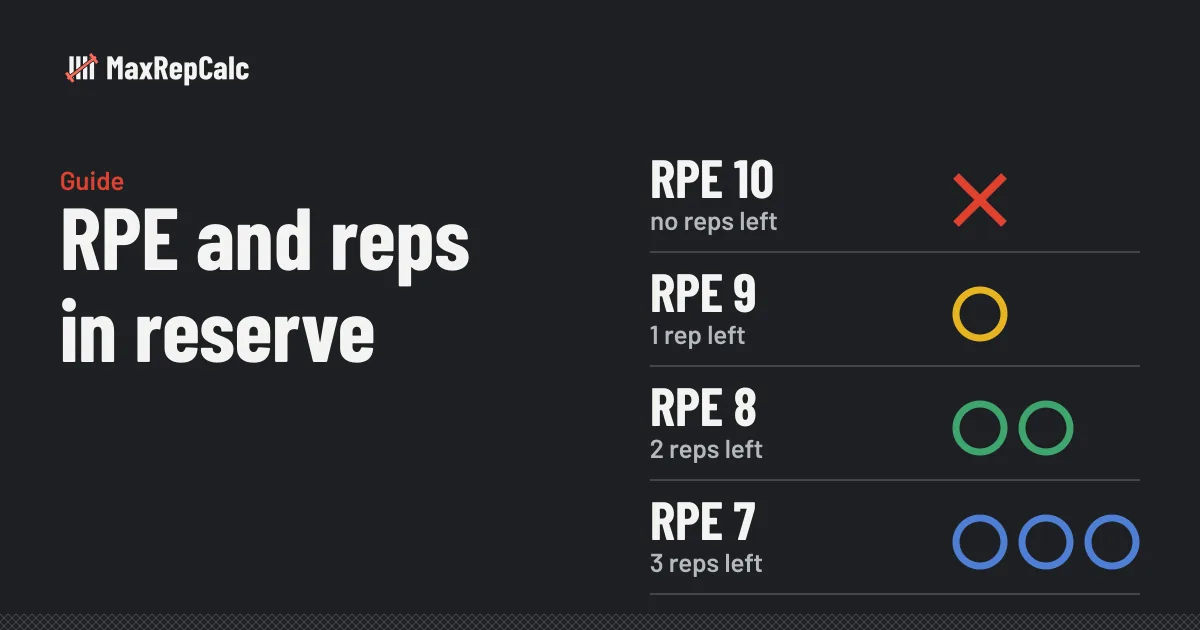
Here is the common version of the scale. Each RPE number maps to a number of reps left in reserve.
| RPE | Reps left | What it means |
|---|---|---|
| 10 | 0 | Maximum effort. You could not have done another rep. |
| 9.5 | 0 to 1 | No more reps, or a very hard last rep with maybe one more possible. |
| 9 | 1 | One more rep was possible. |
| 8 | 2 | Two more reps were possible, but not three. |
| 7 | 3 | Three more reps were possible. |
| 5 to 6 | 4 to 6 | Light to moderate work with plenty in hand. |
RPE 8 to 10 covers the hard sets that drive most strength work. If you cannot tell whether a set was an 8 or a 9, you are in good company, and the next section explains why.
How accurate are lifters at judging reps in reserve?
Not as accurate as most people think, but good enough to be useful. A scoping review by Halperin and colleagues pooled 13 publications, 12 studies and 414 participants. On average, people predicted about one rep fewer than they could actually do. Experience and sex did not clearly change the result.
Two details matter for how you use the scale. Predictions were better when the set was close to failure, and they were better in sets of 12 reps or fewer. Stronger By Science, which summarizes this research, also cites a study in which 24 resistance trained lifters predicted their reserve on the bench press with an average error of 0.65 reps. In another study, certified coaches who watched video of sets guessed the reserve with an average error of 4.8 reps at the start of a set, 2.0 reps two thirds of the way through and 1.2 reps near the end.
The lesson is simple. Judge your effort late in the set, near failure, and treat a guess of two reps left as a range of one to three. If you rely on reps in reserve for a 1RM estimate, keep the sets short, take them close to failure and read the result as a range.
How RPE changes a 1RM estimate
A formula expects a set taken to failure. When you stop short, the set understates what you can do. The reserve box fixes that by counting the reps you had left. Here is one set, 100 kg for 5 reps, with a different number of reps left each time.
| Reps left | Counted as | Mean estimate | Range |
|---|---|---|---|
| 0 | 5 reps | 115.5 kg | 112.5 to 119.0 kg |
| 1 | 6 reps | 118.5 kg | 115.0 to 121.5 kg |
| 2 | 7 reps | 121.6 kg | 117.5 to 124.0 kg |
| 3 | 8 reps | 124.7 kg | 120.0 to 127.7 kg |
A set at RPE 10 gives a mean of 115.5 kg. The same weight and reps at RPE 8, with two reps left, counts as 7 reps and gives 121.6 kg, about 6 kg higher. The weight lifted did not change. Only your honesty about the effort changed.
Because lifters tend to guess too few reps left, a reserve of 2 may really be 3. That makes the estimate slightly cautious, which is a safe direction for planning. Use the reserve box when a set was clearly short of failure, and leave it at 0 when you are unsure.
RPE or percentages: which should you use?
Both work. Stronger By Science summarizes an eight week trial of 21 trained men that compared loading by RPE with loading by percent of 1RM. Both groups gained strength and muscle, and the differences between them were not significant.
Many lifters combine the two. A percentage from a 1RM estimate sets the starting weight, and RPE adjusts it on the day. Suppose your estimate is 115.5 kg and your program calls for 5 reps at RPE 8. A set of 5 sits at about 86.6% of 1RM, which is 100.0 kg, but that is a set at RPE 10. For RPE 8, a lifter would count the set as 7 reps and choose a weight near 95.0 kg, then adjust by feel.
How to get better at judging reps in reserve
- Judge late. Make your call on the last two or three reps, not the first.
- Stay at 12 reps or fewer. Reserve guesses are worse in long sets.
- Calibrate safely. Occasionally take a set closer to failure on a lift where a miss is safe, such as a machine or a lift with safety bars, then compare the result with your guess.
- Keep notes. Write down your guess for each hard set and what actually happened.
- Expect to guess low. If you think you had two left, plan as if you may have had three.
Using RPE across a training week
Many programs ask for different effort on different days. A heavy day might call for sets at RPE 8 to 9, while a lighter day might call for RPE 6 to 7. Reps in reserve make that easy to carry out: you pick a weight, stop when you have the right number left, and write down the result.
Over a few weeks the log becomes useful. If the same weight moves from RPE 9 to RPE 8, you are getting stronger, even if your 1RM was never tested. If it creeps from RPE 8 to RPE 9, you may need more rest.
Common mistakes with RPE
- Rating the first rep. Effort should be judged at the end of the set, not the start.
- Confusing slow with hard. A slow rep is not always a hard one. Count how many reps you could still do.
- Using RPE on long sets. Judgments are weaker in sets above about 12 reps.
- Rounding up your effort. Calling every hard set a 10 removes the information the scale is meant to give.
Worked example: a bench session
A lifter benches 80 kg for 6 reps and rates the set RPE 8. That is two reps left, so the set counts as 8 reps. The estimate is 99.8 kg, with a range of 96.0 to 102.1 kg.
Had the lifter gone to failure at 6 reps, the estimate would have been 94.8 kg. A set of 5 at the higher estimate would sit near 86.4 kg, against 82.1 kg from the lower one. That gap is the cost of ignoring effort. The bench press 1RM calculator uses the same numbers with notes for the bench.
RPE and reps in reserve questions
What does RPE 8 mean?
RPE 8 means a set felt hard, with about two reps left in reserve. You could have done two more reps with good technique, but not three. In this calculator, a set of 5 at RPE 8 counts as a set of 7, because you stopped two reps before failure.
Is RPE the same as reps in reserve?
They are linked, not identical. RPE rates how hard a set felt on a 1 to 10 scale. Reps in reserve counts how many reps you had left. The common scale ties each number to a reserve: RPE 10 is zero left, RPE 9 is one left and RPE 8 is two left.
How accurate is my reps in reserve guess?
Most lifters are off by about one rep, and they usually guess too few reps left. A review of 12 studies found people predicted about one rep fewer than they could do. Guesses improve close to failure and in sets of 12 reps or fewer.
Should I use RPE or percentages?
Either works. An eight week trial of trained men found similar gains from RPE loading and percentage loading. Many lifters use both: percentages from a 1RM estimate set the starting weight, and RPE adjusts it on the day for sleep, stress and recovery.
Keep reading
- How to test your 1RM safely: what to do when you want a real number instead of an estimate.
- Training max guide: how to turn an estimate into a base for your weekly sets.
Sources and review
- Zourdos MC, Klemp A, Dolan C, et al. Novel resistance training-specific rating of perceived exertion scale measuring repetitions in reserve. Journal of Strength and Conditioning Research. 2016;30(1):267-275. doi:10.1519/JSC.0000000000001049
- Androulakis-Korakakis P. Overshooting, undershooting, or just right? How to perfect your ability to predict repetitions in reserve. Stronger By Science. 2024. strongerbyscience.com.
- Halperin I, et al. Accuracy in predicting repetitions to task failure in resistance exercise: a scoping review and exploratory meta-analysis. Sports Medicine. doi:10.1007/s40279-021-01559-x
- LeSuer DA, McCormick JH, Mayhew JL, Wasserstein RL, Arnold MD. The accuracy of prediction equations for estimating 1-RM performance in the bench press, squat, and deadlift. Journal of Strength and Conditioning Research. 1997;11(4):211-213. Abstract
These are estimates for training. They are not medical advice. Read the disclaimer.